Bus power
The pi will limit the power available to your device on the USB bus due to its power limitations. I am using a USB hub and supplying 5v @ 3A. This tells the pi to STFU
import os
os.system("echo 1 > /sys/bus/usb/devices/1-1.3/bConfigurationValue")
os.system("echo 1 > /sys/bus/usb/devices/1-1.4/bConfigurationValue")
Non Serial GPS?
I have a Bluetooth one.
#!/bin/sh
sudo rfcomm bind /dev/rfcomm0 00:15:4B:01:84:EC
Don’t use my mac address use your own!
WiFi Won’t reconnect
Stupid thing, I put it in my pocket and walked out of WiFi range for a bit.
I am back in WiFi range, still no pi. Cron and Script fix…
#!/bin/bash

#echo "Script was run @ $(date)" >>/var/log/wifi_reconnect

# The IP for the server you wish to ping
SERVER=$(/sbin/ip route | awk '/default/ { print $3 }')

#echo "> Server: ${SERVER}" >>/var/log/wifi_reconnect

# Specify wlan interface
WLANINTERFACE=wlan0

#echo "> WLAN Interface: ${WLANINTERFACE}" >>/var/log/wifi_reconnect

# Send two pings, sending output to /dev/null
ping -I ${WLANINTERFACE} -c2 ${SERVER} >/dev/null

# If the return code from ping ($?) is not 0 (meaning there was an error)
if [ $? != 0 ]
then
#echo "> WiFi no worky. Restart!" >>/var/log/wifi_reconnect
# Restart the wireless interface
ip link set wlan0 down
ip link set wlan0 up
#else
#echo "> WiFi works. No restart" >>/var/log/wifi_reconnect
fi
Unicode Linux
To enter a font glyph’s code on Linux, use a combination of keys and the character’s hexadecimal code. The most common method is Ctrl + Shift + U followed by the hexadecimal code and then pressing Enter
Forgot the time
Less than one second
| Multiple of a second | Unit | Symbol | Definition | Comparative examples & common units |
|---|---|---|---|---|
| 10−44 | Planck time | tP | Presumed to be the shortest theoretically measurable time interval (but not necessarily the shortest increment of time—see quantum gravity) | 10−14 qs: The length of one Planck time (tP = ℏ G / c 5  ≈ 5.39×10−44 s)[3] is the briefest physically meaningful span of time. It is the unit of time in the natural units system known as Planck units. ≈ 5.39×10−44 s)[3] is the briefest physically meaningful span of time. It is the unit of time in the natural units system known as Planck units. |
| 10−30 | quectosecond | qs | Quectosecond, (quecto- + second), is one nonillionth of a second | |
| 10−27 | rontosecond | rs | Rontosecond, (ronto- + second), is one octillionth of a second | 300 rs: The mean lifetime of W and Z bosons |
| 10−24 | yoctosecond | ys[4] | Yoctosecond, (yocto- + second), is one septillionth of a second | 86 ys: The estimated value on the half-life of isotope 5 of hydrogen (hydrogen-5) 143 ys: The half-life of the nitrogen-10 isotope of nitrogen 156 ys: The mean lifetime of a Higgs Boson |
| 10−21 | zeptosecond | zs | Zeptosecond, (zepto- + second), is one sextillionth of one second | 1.3 zs: Smallest experimentally controlled time delay in a photon field.[5] 2 zs: The representative cycle time of gamma ray radiation released in the decay of a radioactive atomic nucleus (here as 2 MeV per emitted photon) 4 zs: The cycle time of the zitterbewegung of an electron ( ω = 2 m e c 2 / ℏ 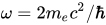 ) )247 zs: The experimentally-measured travel time of a photon across a hydrogen molecule, “for the average bond length of molecular hydrogen”[6] |
| 10−18 | attosecond | as | One quintillionth of one second | 12 as: The best timing control of laser pulses.[7] 43 as: The shortest X-ray laser pulse[8] 53 as: The shortest electron laser pulse[9][10] |
| 10−15 | femtosecond | fs | One quadrillionth of one second | 1 fs: The cycle time for ultraviolet light with a wavelength of 300 nanometres; the time it takes light to travel a distance of 0.3 micrometres (μm). 7.58 fs: The period of vibration of a hydrogen molecule. 140 fs: The time needed for electrons to have localized onto individual bromine atoms 6 Ångstrom apart after laser dissociation of Br2.[11] 290 fs: The lifetime of a tauon |
| 10−12 | picosecond | ps | One trillionth of one second | 1 ps: The mean lifetime of a bottom quark; the time needed for light to travel 0.3 millimetres (mm) 1 ps: The typical lifetime of a transition state one machine cycle by an IBM silicon-germanium transistor 109 ps: The period of the photon corresponding to the hyperfine transition of the ground state of cesium-133, and one 9,192,631,770th of one second by definition 114.6 ps: The time for the fastest overclocked processor as of 2014 to execute one machine cycle.[12] 696 ps: How much more a second lasts far away from Earth’s gravity due to the effects of general relativity |
| 10−9 | nanosecond | ns | One billionth of one second | 1 ns: The time needed to execute one machine cycle by a 1 GHz microprocessor 1 ns: The time light takes to travel 30 cm (11.811 in) |
| 10−6 | microsecond | μs | One millionth of one second | 1 μs: The time needed to execute one machine cycle by an Intel 80186 microprocessor 2.2 μs: The lifetime of a muon 4–16 μs: The time needed to execute one machine cycle by a 1960s minicomputer |
| 10−3 | millisecond | ms | One thousandth of one second | 1 ms: The time for a neuron in the human brain to fire one impulse and return to rest[13] 4–8 ms: The typical seek time for a computer hard disk |
| 10−2 | centisecond | cs | One hundredth of one second | 1.6667 cs: The period of a frame at a frame rate of 60 Hz. 2 cs: The cycle time for European 50 Hz AC electricity 10–20 cs (=0.1–0.2 s): The human reflex response to visual stimuli |
| 10−1 | decisecond | ds | One tenth of a second | 1–4 ds (=0.1–0.4 s): The length of a single blink of an eye[14] |